A story shaped around one real moment
Create a Personalized Bedtime Story From Their Day
A personalized bedtime story begins with something your child actually felt, noticed, tried, or found difficult today. Lullaly turns that small moment into an original story with a new character and setting, so you can read it aloud tonight without copying private details word for word.
Create tonight's storyWhat Is a Personalized Bedtime Story?
A personalized bedtime story is a story shaped around a particular child's recent experience while still reading like a complete piece of fiction. Instead of choosing a generic tale about bravery, friendship, or change, a parent starts with one concrete moment: a tower fell, a lesson felt unfamiliar, a friend would not share, or saying goodbye was hard. The story preserves the emotional center of that moment but changes the names, place, dialogue, and plot into an original imaginative frame.
That balance matters. Personalization should create recognition, not a transcript. A child may recognize the worry of standing outside a new group in Pip the field mouse, yet the story does not publish the child's real school, classmates, or exact words. The parent receives something familiar enough to feel relevant and distant enough to explore safely at bedtime.
Why a Personalized Bedtime Story Works
Children often revisit the emotional shape of a day long after the practical problem is over. Direct questions can feel demanding when everyone is tired, and advice can sound like one more correction. A personalized bedtime story gives the experience a beginning, middle, and ending. The fictional character can pause, make a small choice, accept help, or discover a different way forward without requiring the child to explain or defend what happened.
The purpose is not to hide a lesson inside a story or promise that every problem will disappear. Lullaly keeps hard feelings believable. A nervous character can remain nervous while finding one familiar sign. An angry character can need time before touching the fallen blocks. A friendship can begin to repair without a forced apology. This gentler pace supports conversation because the parent and child can wonder about the character together rather than deciding who was right.
How to Generate a Personalized Bedtime Story
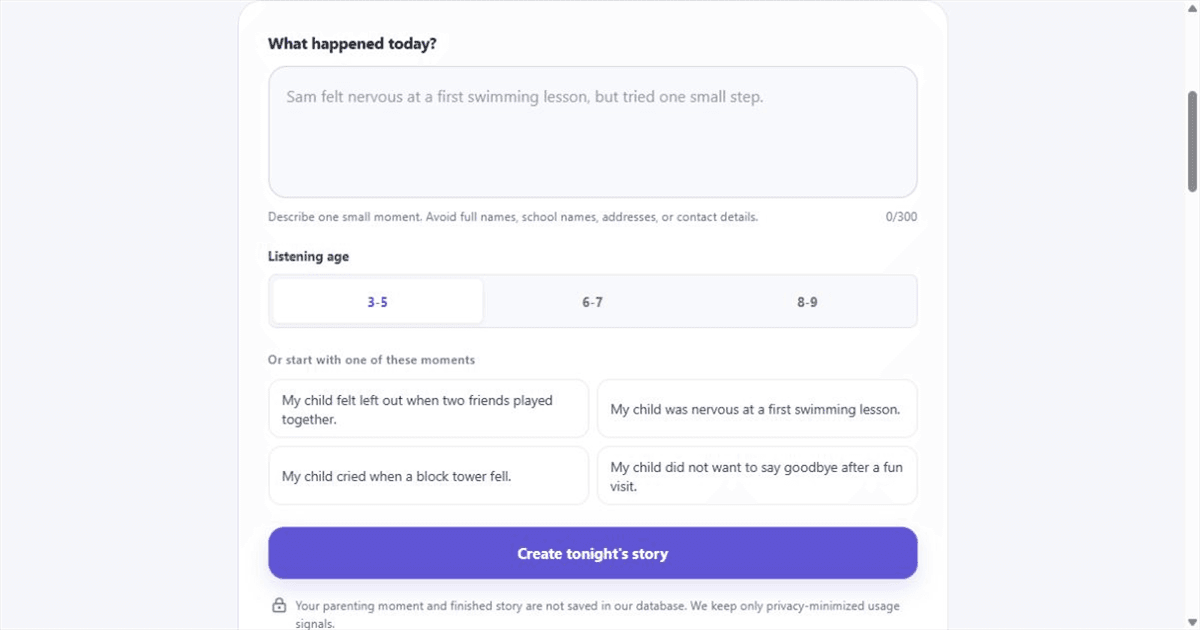
Begin with one small moment from today, not a full history. Describe what happened and the feeling you noticed in 300 characters or fewer. Avoid full names, school names, addresses, contact details, diagnoses, and anything the story does not need. Then choose the listening age: 3–5, 6–7, or 8–9. Lullaly adjusts vocabulary, story length, dialogue, and plot complexity for that age band while keeping the same gentle bedtime purpose.
After you select Create tonight's story, read the result before sharing it. AI can make mistakes, so the adult remains the editor and storyteller. You can copy a useful result, create another version, or change the starting moment to focus on a different part of the day. Each story ends with one open bedtime question designed to invite connection rather than test comprehension.
- Describe one event: what happened, what your child seemed to feel, and one detail that mattered.
- Choose ages 3–5 for shorter concrete language, 6–7 for a fuller turn, or 8–9 for richer description and dialogue.
- Review the story, remove anything that does not fit your family, and read it in your own voice.
A Complete Personalized Bedtime Story Example
Starting moment: A child wanted to join a playground game but stayed nearby because asking felt difficult. The story keeps the uncertainty and wish to belong, then changes the playground into a moonlit meadow and the child into an original field mouse named Pip.
Pip and the Silver-Grass Circle
When evening reached the meadow, the silver grass began to shine. Crickets gathered in a wide circle and tapped a dancing rhythm with their feet. Pip the field mouse watched from beneath a clover leaf. He knew the song. His paws even moved when nobody was looking. But the question he wanted to ask felt tucked behind his whiskers.
Pip walked near the circle, then stopped beside a smooth stone. The crickets turned, hopped, and laughed when anyone missed a beat. They did not look unkind. Still, every space seemed to close just before Pip reached it. He told himself that watching was enough, although his toes kept tapping in the dust.
A pale moth landed on the stone beside him. She did not ask why he was quiet. She simply folded her wings and listened. After a while she said, ‘The song sounds different from over here.’ Pip nodded. ‘I know the steps,’ he whispered, ‘but I do not know how to enter.’
The moth looked toward the dancers. ‘Perhaps entering can be one small step, not the whole dance.’ Pip breathed in the scent of clover. The question was still behind his whiskers, but now there was a little room around it. He moved from the stone to the edge of the silver grass.
One cricket noticed his tapping foot. Pip's heart beat faster than the music. He did not make a speech. He asked, ‘Could there be room for one more step?’ The cricket shifted sideways. The opening was small, but it was real. Pip placed one paw inside the circle and tapped the beat he already knew.
He missed the next turn and bumped gently into a grass stem. Nobody laughed at him. One cricket missed the turn after that, and the circle wobbled like a ring of moonlight on water. Pip tried again. Soon he was not thinking about entering. He was listening, stepping, and making the song a little fuller.
At bedtime, Pip remembered that the question had not become easy before he asked it. His whiskers had trembled, and his heart had raced. Courage had not arrived like a trumpet. It had been one quiet breath, one honest question, and one small place opening in the silver grass.
Personalized Bedtime Story Prompts by Educational Theme
You do not need to write a complicated prompt. Choose the theme that matches the real moment and describe what happened without prescribing a moral. The generator can build the lesson through character choices, consequences, support, and repair instead of having an adult character announce the answer.
- Friendship: My child felt left out when two friends started a game together and did not know how to join.
- Sharing: My child held tightly to a favorite toy after another child asked for a turn, and both children became upset.
- Frustration: A block tower fell near the end of play, and my child yelled and pushed the remaining blocks away.
- Starting school: My child is worried about where to sit and whether anyone will talk to them on the first day.
- Trying something new: My child felt nervous at a first swimming lesson but put one foot in the water.
- Goodbyes: My child did not want a happy visit to end and cried when it was time to leave.
- Patience: A plan changed unexpectedly, and waiting for the next chance felt almost impossible.
- Repair: My child said something hurtful during an argument and now wants to find a way back to the friendship.
Personalized Bedtime Stories by Age
For ages 3–5, a personalized bedtime story uses short sentences, concrete images, gentle repetition, and a single clear conflict. The cast stays small, and the character usually takes one visible next step. A fallen tower might become three glowing blocks placed side by side, giving the child an ending that can be pictured easily.
For ages 6–7, the story can hold a little more dialogue, emotional nuance, and one turn in the plot. The character may want two things at once, such as keeping a special bell while also missing a friend. For ages 8–9, the language can become richer and the social situation more layered. The story may explore uncertainty, responsibility, or repair without rushing to a neat answer. In every age band, the adult reads first and decides whether the story suits the child and the moment.
Privacy When You Personalize a Bedtime Story
A useful personalized bedtime story needs the emotional shape of a moment, not a child's identity. Use a first name only if necessary, or leave names out entirely. Do not enter school names, exact locations, addresses, phone numbers, email addresses, medical details, or other information that could identify a child. Lullaly's application does not save the submitted moment or generated story in its database, logs, or analytics, although the input is sent to the configured AI provider so the story can be generated.
The service also checks inputs and completed output for unsafe material, but no automated system is perfect. Review every result before reading it aloud. If a story touches a serious safety, medical, developmental, or mental-health concern, use appropriate professional support rather than treating an AI story as diagnosis, therapy, or urgent guidance.
Personalized Bedtime Story FAQ
What should I include in a personalized bedtime story prompt?
Include one recent event, the feeling or reaction you noticed, and one detail that gave the moment meaning. Keep it under 300 characters and leave out full names, school names, addresses, contact details, diagnoses, and other identifying information.
Can I choose the age for the story?
Yes. Choose ages 3–5, 6–7, or 8–9. The selected band changes vocabulary, sentence length, plot complexity, dialogue, and approximate reading length while preserving a calm parent-led bedtime format.
Does a personalized story repeat my child's real day exactly?
No. Lullaly keeps the central feeling and transforms identifying details into original characters, settings, and events. The goal is recognition with imaginative distance, not a transcript of a child's private experience.
Should I review the story before reading it aloud?
Always. AI can misunderstand context or produce details that do not fit your child. Read the whole result, edit or skip anything unsuitable, and use your own judgment about whether the story belongs in tonight's routine.